The Real Cost of a Slippery Floor
Every business that opens its doors to employees, clients, or the public accepts a set of legal responsibilities. Among the most basic — yet frequently overlooked — is to ensure that floors, walkways, and work areas are safe. It sounds simple, but the implications are serious. A single slip, trip, or fall can trigger an entire chain of events: injury, compensation claims, investigations, insurance disputes, and long-term damage to the brand.
If a business knows that its floors become dangerously slippery when wet but does nothing beyond placing a small caution sign, it hasn’t met its legal duty of care. An insurer can treat this negligence as a breach of policy conditions and refuse to cover the claim. In that moment, a “simple accident” becomes a full crisis — both legally and financially.
Why “Reasonable Steps” Matter
Health and safety law doesn’t expect businesses to eliminate every possible risk. Instead, it expects that reasonable steps are taken to reduce known hazards. This standard — “reasonably practicable” — means weighing the likelihood and severity of harm against the time, effort, and cost of reducing the risk.
Let’s break it down with a practical example:
- The business knows the entrance floor becomes slippery when it rains.
- A wet floor sign is available but does little to stop slips.
- Anti-slip mats or coatings could significantly reduce risk at modest cost.
By choosing not to install better surfaces, the business has failed to take reasonable steps. The accident that follows is therefore foreseeable and preventable — two key words that define negligence in law.
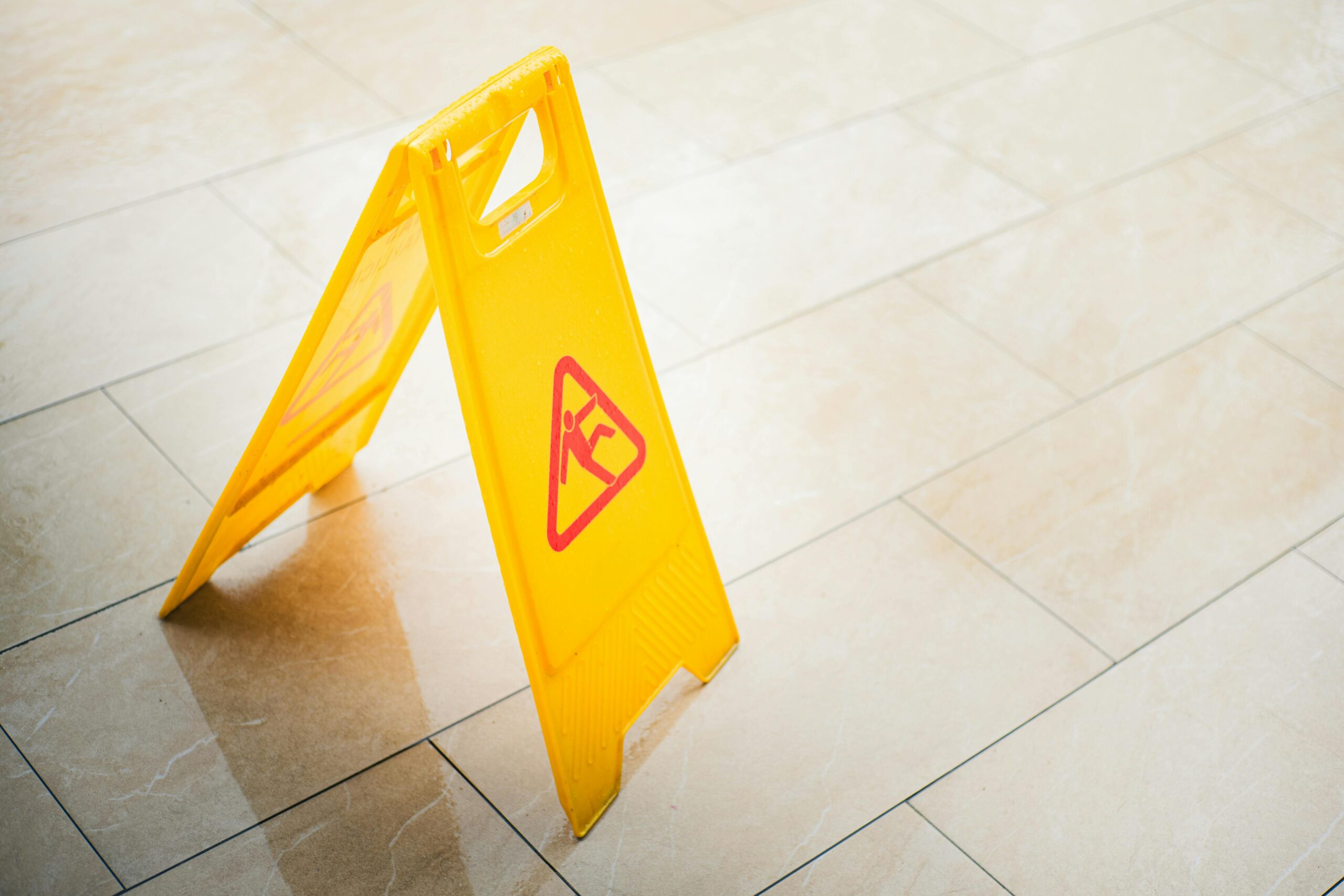
The Illusion of the “Wet Floor” Sign
Many managers assume that placing a “wet floor” sign automatically demonstrates due diligence. It doesn’t.
Warning signage only alerts people to a hazard; it doesn’t correct it. If the flooring remains highly slippery, particularly in a high-traffic or public area, the sign becomes more of a legal fig leaf than a control measure.
Courts and insurers routinely reject claims for coverage where businesses rely solely on signage without proof of real action. For example, suppose CCTV shows that no effort was made to clean or cordon off the area, or that the surface had long been known to lack traction. In that case, the insurer can categorically state that the business neglected its duty.
The sign is a communication tool, not a solution. True risk control requires physical and procedural interventions that eliminate or minimize danger.
Legal Duty of Care: What the Law Demands
In the UK, the primary legal framework for workplace and public area safety comes from the Health and Safety at Work etc. Act 1974, supported by various regulations such as the Management of Health and Safety at Work Regulations 1999 and Workplace (Health, Safety and Welfare) Regulations 1992.
Under these, an employer or occupier must ensure that floors and traffic routes are kept in good condition and free from obstructions or substances likely to cause slips or falls. The law also requires regular risk assessments and the implementation of control measures suited to each site.
Failure to comply doesn’t just expose the business to civil claims — it can result in criminal prosecution. In serious cases where negligence leads to serious injury or death, directors or business owners themselves can face personal liability, fines, or even imprisonment.
When Insurance Refuses to Pay
Insurance policies include conditions that require the insured party to maintain premises safely and comply with legal duties. If an insurer finds evidence that a hazard was known but ignored, they can lawfully decline cover.
This refusal can be based on:
- Negligence in maintaining safety standards.
- Failure to implement risk assessment recommendations.
- Lack of documented cleaning and maintenance records.
- Prior complaints or incidents indicating an ongoing issue.
Once a policy is invalidated, the business must pay all damages out of pocket — from compensation to legal representation and rehabilitation costs for the injured person. The financial impact can run to tens or even hundreds of thousands of pounds.
Personal Liability for Business Owners
Many small business owners assume that limited company status shields them from personal risk. In practice, that protection only extends as far as the law allows. If a director or manager is found personally negligent — meaning they ignored known risks or failed to implement basic safety procedures — they can be held personally liable.
Health and Safety Executive (HSE) investigations often look beyond the incident itself. They assess whether leadership demonstrated proactive control of safety measures. If not, prosecution under sections 7 or 37 of the Health and Safety at Work Act may follow, bringing personal fines or criminal records into play.
In short, safety negligence doesn’t always stop at the company’s doorstep. It can reach the individual decision-makers who allowed the conditions to persist.
The True Scope of Liability
When an injury claim progresses, the potential costs extend far beyond the initial compensation amount. Businesses may be responsible for:
- Medical and rehabilitation costs: physiotherapy, surgery, or specialist care.
- Loss of earnings: compensation for time off work or long-term income loss.
- Legal fees: defense costs and claimant’s legal expenses.
- Regulatory penalties: fines issued by HSE or local authorities.
- Reputational damage: loss of contracts or customer trust after publicized incidents.
Even a low-severity claim — for example, a twisted ankle — can snowball into a major financial burden when legal and administrative costs are factored in. The true risk is not just injury but business continuity.
Building a Culture of Prevention
Slip prevention isn’t simply about compliance; it’s about culture. Employees and managers alike must view safety as an integral part of business operations. Start by building consistent routines:
- Conduct regular floor audits. Check for worn surfacing, poor drainage, or buildup of residues.
- Implement cleaning protocols. Document when and how floors are cleaned or treated.
- Use correct flooring materials. Choose anti-slip tiling, mats, or coatings designed for your environment.
- Train staff. Ensure that everyone understands spill response and signage procedures.
- Keep records. Maintenance logs and cleaning schedules provide vital evidence for insurance and HSE reviews.
When these steps are embedded into daily operations, the risk of a claim drops dramatically — and insurers view the business as a responsible policyholder.
Practical Steps for Compliance
For businesses uncertain about their current standards, here’s a quick roadmap to compliance:
- Risk Assessment: Identify where slips are most likely and document findings.
- Mitigation Plan: Install anti-slip materials and improve drainage or ventilation where needed.
- Maintenance Schedule: Regularly inspect and repair flooring.
- Emergency Response: Designate staff to isolate and clean spills immediately.
- Review and Update: Revise procedures annually or after any incident.
These aren’t just best practices — they’re evidence of active management, the kind insurers and regulators expect to see.
The Bottom Line
Slip prevention isn’t optional. It’s a legal, ethical, and financial imperative. A wet floor sign alone may feel like a quick fix, but without real hazard control, it’s no defence in law or insurance. Business owners must recognize that the true cost of inaction can go far beyond a single incident.
Insurers can refuse cover, courts can order full compensation, and regulators can impose penalties. The question isn’t whether accidents can be fully prevented — it’s whether the business can demonstrate it did everything reasonably possible to stop them.
In a world where compliance and accountability matter more than ever, maintaining safe floors is not just good practice — it’s good business.
Would you like this post tailored for a specific audience (e.g., small business owners, facility managers, or insurance industry readers)?
If a business has not taken reasonable steps to prevent a known hazard — such as a floor that becomes dangerously slippery when wet — an insurer may legally refuse the claim. A wet floor sign alone does not prove risk control. If the surface is still unsafe, the accident is considered foreseeable and preventable.
In these cases, the business — and in some circumstances the owner or director personally — can be held liable for full compensation, legal fees, rehabilitation and care costs, loss-of-earnings claims, and HSE (Health and Safety Executive) investigation penalties.
Slip prevention is not optional; it is a legal duty of care.
Effective risk management involves a combination of warnings, immediate action, and long-term strategies to ensure safety and compliance with the law.